1

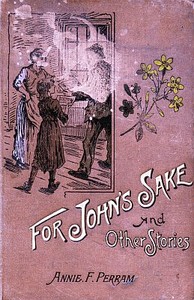
For John's Sake, and Other Stories. — A Closer Reading
4
1
Project Gutenberg
2010
Short stories, English; Temperance -- Fiction
Readers of public-domain and historical texts
Project Gutenberg digital edition
en
Edition facts
Words: 48,026
Reading time: 209 min
Text sections: 6
Source:
Project Gutenberg record #31785
Annie Frances Perram's collection of temperance tales, including the title story 'For John's Sake,' dramatizes the social pressures and personal consequences of alcohol consumption through domestic and church settings, with a preface claiming fidelity to observed incidents.
Editorial Edition Score
4.7/5
★★★★★
★★★★★
Calculated from edition completeness, EPUB availability, text structure and catalogue metadata. Not a user rating.
Edition quality
Annie Frances Perram's preface to For John's Sake, and Other Stories asserts that the darkest pictures in the collection are 'minutely faithful to life' and that the saddest incidents occurred under her personal observation or within her knowledge. This claim of documentary veracity frames the twelve stories that follow, which repeatedly stage scenes of persuasion and coercion around alcohol. The title story opens with parlour-maid Ruth and gardener John being summoned by their employer, Mr. Groombridge, who reveals that the household knows of their engagement—a moment that quickly gives way to a pattern of social pressure to drink. The excerpt from 'How a Husband Was Lost and Found' shows a minister confronting a deacon about how well-meaning hospitality, including persistent offers of wine, contributed to his past alcoholism. These scenes share a recurring structural device: a character is urged to accept a drink, and the narrative traces the moral and emotional weight of that moment.
Domestic Settings and Hierarchies
The excerpts consistently place pivotal conversations in domestic interiors: a dining room during dessert, a conservatory, a kitchen, a parlour. In 'For John's Sake,' the Groombridge family summons servants John and Ruth to the dining room, where the master speaks with 'a kind look and kinder tone' about their engagement. The physical arrangement—Ruth blushing and withdrawing behind John—underscores the power dynamics. Later, in 'How a Husband Was Lost and Found,' the deacon and his wife discuss the minister's rebuke in their own home, with Mrs. Green recalling how she 'pretended to be hurt' when the minister declined wine. These settings are not neutral backdrops; they are stages where hospitality becomes a tool of social expectation. The stories repeatedly show that the offer of alcohol is inseparable from the giver's status and the recipient's perceived obligation.
The Rhetoric of Persuasion
Perram's dialogue is built around a specific persuasive vocabulary. Characters frame alcohol as a remedy: the minister is told he 'needed to be stimulated for my work' or that he looked 'white and exhausted' and must take 'just one glass.' Refusal is met with social penalties—a 'personal slight' if a visitor 'refused the proffered wine.' Mrs. Green admits she felt 'exultant' when she overcame the minister's reluctance. The deacon's wife uses the phrase 'liberty of action' sarcastically, while the minister accuses the deacons of never allowing him to 'decline your offer of wine or spirits.' This language of compulsion disguised as kindness recurs across stories, suggesting a deliberate pattern: the temperance argument is not merely about individual willpower but about the social machinery that erodes it.
Consequences and Confrontations
The excerpts show that the stories do not end with the drink being taken; they trace aftermaths. In 'How a Husband Was Lost and Found,' the minister's confrontation leads the deacon to groan, bury his face in his hands, and later weep with his wife as they acknowledge guilt: 'the blood of souls is on our garments.' Mrs. Green breaks down 'utterly.' The resolution is a mutual vow to stop offering intoxicants to guests. This pattern—a character's accusation, followed by remorse and a pledge—appears in multiple excerpts. The preface's claim that incidents are 'minutely faithful to life' suggests Perram intends these confrontations as instructive models. The stories function as moral exempla, where the moment of pressure is dramatized, the harm is named, and a corrective decision is made, often by the person who previously applied the pressure.
Readers approaching For John's Sake, and Other Stories will find that the temperance message is embedded not in abstract sermons but in repeated, concrete social rituals: the offer, the refusal, the insistence, the eventual capitulation or the belated recognition of harm. Perram's method is to dramatize the micro-decisions that accumulate into ruin, and her preface asks to be taken as witness rather than invention. The stories reward attention to who speaks, who pours, and who feels compelled to accept.
Reader reflection
Record your reading impressions
A brief reflection can help important ideas stay with you longer.
Your progress
0
/
10
2
How much did you enjoy the reading experience?
3
How likely are you to recommend this book?
4
What was the reading difficulty like?
5
Would a second reading be valuable?
6
Which aspect of the book did you value most?
7
Would you like to discuss this book with someone?
8
What did you think about the pace?
9
In one sentence, what did you learn?
10