
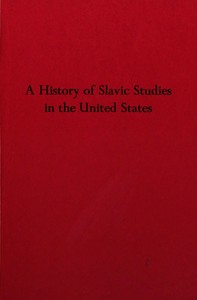
A history of Slavic studies in the United States by Clarence Augustus Manning
Clarence Augustus Manning's book is a straightforward account of how Americans began to formally study the languages, histories, and cultures of Slavic peoples. He starts at the very beginning, in the late 1800s, when a handful of scholars first introduced these subjects. The story follows the field's growth through the early 20th century, detailing the founding of university departments, the creation of important journals, and the key figures who did the work.
The Story
Manning maps out a journey of ideas. He shows us the initial, often isolated, efforts by professors who had to build their own teaching materials from limited resources. The narrative picks up speed with World War I and the Russian Revolution, events that made understanding Eastern Europe a sudden national priority. He then covers the interwar period, a time of more stable growth, before detailing the massive expansion triggered by World War II and the Cold War. The book is essentially a biography of an academic field, tracing its birth, awkward adolescence, and coming of age.
Why You Should Read It
What makes this book compelling is its personal touch. Manning wasn't just a historian observing from afar; he was a leading Slavicist himself. His writing has the feel of a seasoned guide pointing out landmarks he helped build. You get a real sense of the challenges these scholars faced—from a lack of textbooks to the political tensions that influenced what they could research and teach. It turns the dry idea of 'academic history' into a story about people building something important, piece by piece, often against the odds.
Final Verdict
This book is a must-read for anyone studying Slavic cultures, history, or linguistics, as it provides essential context for their own field. It's also perfect for history buffs interested in how education and area studies develop in response to world events. While it's a scholarly work, Manning's clear, direct style makes it accessible to any curious reader who enjoys stories about how knowledge is made. It's a quiet but powerful look at the foundations of understanding between worlds.
You are viewing a work that belongs to the global public domain. It is now common property for all to enjoy.
Patricia Johnson
5 months agoI decided to give this a try based on a colleague's recommendation, the emphasis on ethics and sustainability within the topic is commendable. It definitely lives up to the reputation of the publisher.
Emily Taylor
11 months agoExceptional clarity on a very complex subject.
Nancy Brown
2 months agoI've gone through the entire material twice now, and the transition between theoretical knowledge and practical application is seamless. Definitely a five-star contribution to the field.
Lucas Harris
1 year agoI started reading out of curiosity and the depth of research presented here is truly commendable. Definitely a 5-star read.

Margaret Brown
5 months agoThis was exactly the kind of deep dive I was searching for, the bibliography and references suggest a high level of research and authority. Definitely a five-star contribution to the field.