
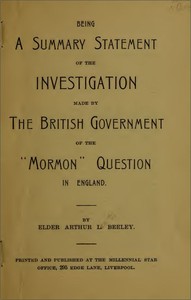
Being a summary statement of the investigation made by the British government…
Let's be clear: this isn't a novel. Arthur L. Beeley's book is a published version of a British government report. It presents itself as the final, authoritative summary of a significant official investigation. The text is formal, procedural, and dense with the language of early 20th-century bureaucracy.
The Story
There isn't a traditional plot with characters. Instead, the 'story' is the investigation itself. The book lays out the scope, methods, findings, and conclusions of a government probe. It details who was questioned, what evidence was considered, and the official line on what happened. The central tension isn't about a person, but about truth versus the official record. You're reading the polished, public-facing conclusion, and part of the experience is reading between the lines, wondering about the debates and disagreements that were smoothed over to produce this single, coherent statement.
Why You Should Read It
I found this book strangely gripping because it's an artifact. It doesn't just talk about history; it is a piece of history. You hold in your hands the exact document that shaped public understanding (or was meant to) of a major event. The formal tone isn't boring—it's the point. It shows you how institutions communicate, justify themselves, and attempt to control a narrative. It’s a masterclass in the language of power. You have to work a bit as a reader, often looking up the historical context separately, but that active engagement makes the discovery all the more rewarding.
Final Verdict
This is not for someone looking for a light narrative. It's perfect for history buffs who love primary sources, true crime readers interested in the anatomy of an investigation, or anyone fascinated by political science and how governments 'spin' events, even a century ago. Think of it as a historical puzzle box. If you enjoy the detective work of history—and don't mind a bit of bureaucratic prose—this unique book offers a direct, unfiltered channel to the past.
You are viewing a work that belongs to the global public domain. Thank you for supporting open literature.
Mason Walker
9 months agoLoved it.
Dorothy Lee
1 year agoCompatible with my e-reader, thanks.
Donald Allen
10 months agoThanks for the recommendation.
Susan Scott
1 year agoThe formatting on this digital edition is flawless.

Kevin Jackson
10 months agoThe layout is very easy on the eyes.