
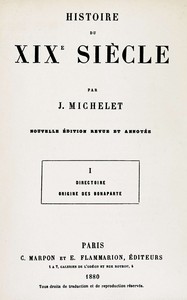
Histoire du XIXe siècle (volume 1/3) : I. Directoire. Origine des Bonaparte
Jules Michelet’s history isn't a simple timeline. It’s a deep, character-driven story about a nation at a crossroads.
The Story
The book opens in the aftermath of the French Revolution’s most violent phase. The old monarchy is gone, but so is the revolutionary idealism. In its place is the Directory, a shaky government led by five directors. France is bankrupt, its people are tired of chaos, and royalists are plotting a comeback. Michelet walks us through the daily struggles of this regime—its financial schemes, its political purges, and its constant battles to stay in power. Woven into this political drama is the rise of the Bonaparte family. We see a young, brilliant, and fiercely ambitious Napoleon returning as a hero from his Italian campaigns. Michelet shows how the Directory’s weaknesses—its corruption, its inability to provide security—created a perfect opening for a military savior. The volume ends with Napoleon not yet in absolute control, but positioned perfectly, waiting for the right moment to seize it.
Why You Should Read It
What makes this book special is Michelet’s voice. He’s not a detached observer; he’s a storyteller who cares deeply about the soul of France. He makes you feel the exhaustion of a nation and the cynical calculations of its leaders. He portrays the Bonapartes not as destiny’s chosen ones, but as a cunning family exploiting a system on the verge of collapse. You get a real sense of how history happens: not through grand plans, but through a thousand small decisions, fears, and accidents. Reading this, you understand that Napoleon didn’t just appear out of nowhere. He was the answer to a very specific, and very desperate, set of problems.
Final Verdict
This is for anyone who loves a great political drama with real-world stakes. It’s perfect for history buffs who want to go beyond the bullet points and feel the texture of the past. It’s also fantastic for readers who enjoy complex characters and stories about how power is really won and lost. Be warned: Michelet writes with a strong point of view. This isn’t an impartial textbook; it’s a passionate argument about how France lost its revolutionary way. If you’re ready for a challenging, opinionated, and utterly absorbing dive into a pivotal moment, this first volume is an incredible start.
This book is widely considered to be in the public domain. Thank you for supporting open literature.
Nancy Moore
8 months agoAfter a thorough walkthrough of the table of contents, the breakdown of complex theories into digestible segments is masterfully done. This is a solid reference for both beginners and experts.
Charles Garcia
8 months agoI stumbled upon this title during my weekend research and the way the author breaks down the core concepts is remarkably clear. Simple, effective, and authoritative – what else could you ask for?
Thomas Martin
10 months agoThought-provoking and well-organized content.
Susan Smith
1 month agoThe clarity of the introduction set high expectations, and the concise summaries at the end of each section are a lifesaver. I feel much more confident in my knowledge after finishing this.









Nancy Thomas
7 months agoMy first impression was quite positive because the structural organization allows for quick referencing of key points. I'll be recommending this to my students and colleagues alike.